
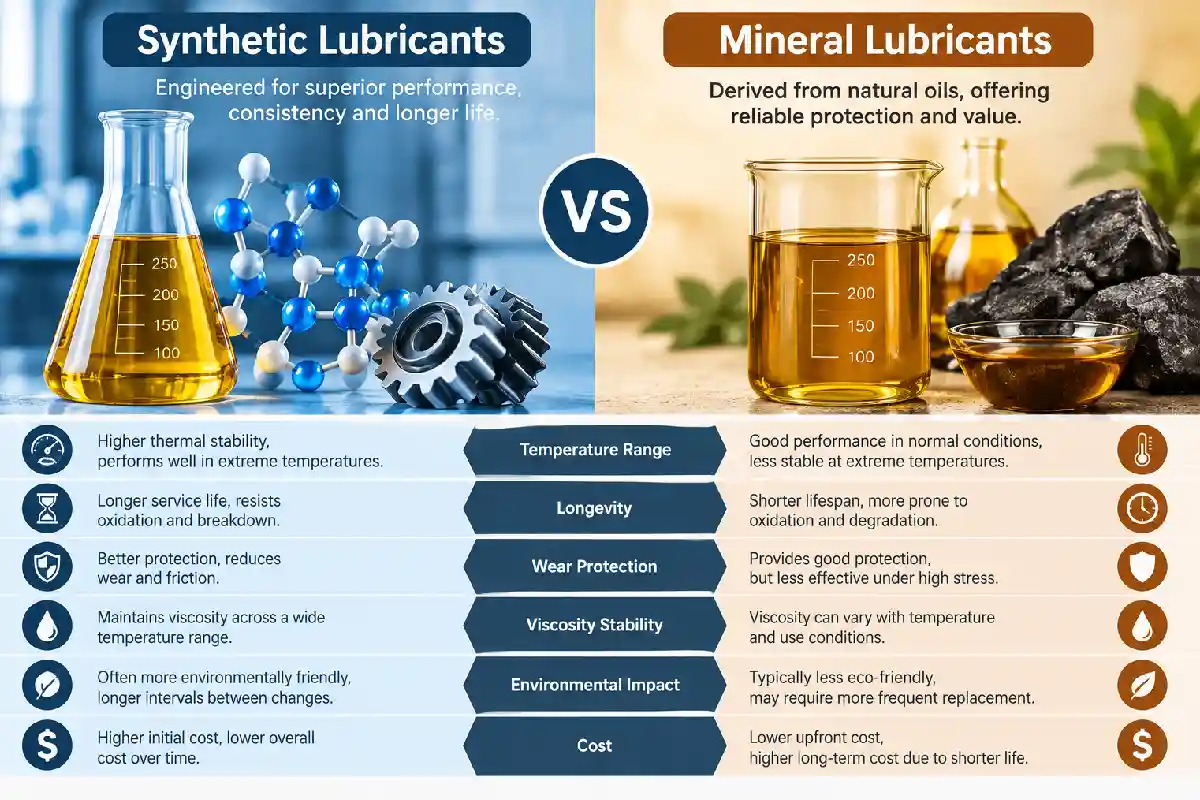
Synthetic vs Mineral Lubricants: Choosing the right industrial lubricants is a crucial priority when it comes to maintaining machinery and ensuring reliable operation.
These products are routinely added to the likes of bearings, gears, compressors, hydraulic systems, and other industrial components and equipment. Such lubrication can help reduce friction, wear, operating temperatures, downtime, and maintenance requirements in the long run.
However, if maintenance professionals at industrial sites are to select the most suitable lubricant for a particular job every time, they will need to know about the differences between synthetic and mineral options.
It is crucial to appreciate that neither mineral nor synthetic lubricants are universally “better” in all circumstances. These two categories of lubricant differ in their characteristics. So, understanding these aspects will help determine which product is the right match for a specific application.
Table of Contents
What Are Mineral Lubricants?
Also sometimes referred to as “conventional” or “petroleum-based” oils, mineral lubricants are produced from crude oil. Refining processes are used that separate and purify the useful hydrocarbon components.
Products in this category have long been used extensively for industrial lubrication. Today, they continue to be a frequently made choice across many applications.
The sustained popularity of mineral lubricants can be largely attributed to their cost-effectiveness for moderate operating conditions.
They can also be a practical choice for machinery designed around conventional mineral-based lubricants, provided the relevant viscosity, performance specification, and material compatibility requirements are met.
What Are Synthetic Lubricants?
Synthetic lubricants use base oils that have been produced or modified through processes designed to achieve more controlled molecular structures and properties (although they are not necessarily created entirely independently of petroleum).
The engineering process for synthetic base oils can result in a fluid with a more controlled composition and fewer undesirable components.
Maintenance personnel often turn to synthetic lubricants because of such products’ ability to deliver reliable performance under demanding operating conditions.
Depending on the formulation, synthetic lubricants can provide good thermal stability, oxidation resistance, and performance across a relatively broad temperature range.
6 Ways in Which Mineral and Synthetic Lubricants Differ from Each Other
The most important differences between mineral and synthetic lubricants relate to their base oils and the performance characteristics of the resulting formulations.
-
Temperature Performance
Mineral lubricants can deliver effective performance across a wide range of operating temperatures. Their viscosity, however, can change considerably with temperature. In this context, the term “viscosity” refers to a lubricant’s resistance to flow.
At low temperatures, the viscosity of mineral oils can go up significantly. This might result in machinery becoming harder to start. When temperatures are high, mineral lubricants may become thinner and their susceptibility to oxidation and degradation can increase.
Many synthetic lubricants, on the other hand, are formulated to maintain more consistent viscosity across changing temperatures. Still, performance does vary between formulations. So, it should never be assumed that a synthetic lubricant will always be the superior choice for every high-temperature application.
-
Oxidation And Thermal Stability
Synthetic lubricants are more resistant to oxidation and thermal degradation than many conventional mineral oils. This depends greatly, however, on the base oil and additives used in the given product.
Indeed, when appropriately formulated, mineral lubricants can also provide good oxidation resistance. This further underscores that maintenance decision-makers need to consider a given product’s specification and the operating conditions in which it will be used, when they are seeking to determine the right product for a particular job.
-
Viscosity And Viscosity Stability
Both mineral and synthetic lubricants are available in a broad range of viscosities. Some synthetic base oils, though, do offer a higher viscosity index. This means their viscosity doesn’t change so markedly as temperature shifts.
Whatever category of lubricant a maintenance staffer ultimately favours, they will need to ensure they pick the right viscosity grade in accordance with the equipment manufacturer’s specifications and the application’s operating conditions.
-
Wear Protection
Lubrication can be critical for reducing direct contact between moving surfaces, limiting friction, and slowing the rate of wear. However, the extent of wear protection that a given lubricant can be expected to provide doesn’t come down to the base oil alone.
The right additives can provide much-needed protection against wear, corrosion, and lubrication degradation. So, it might turn out that while a high-quality mineral lubricant is capable of excellent wear protection in one application, there may be another application where a synthetic formulation would be the wiser choice.
-
Service Life
As far as some demanding applications are concerned, synthetic lubricants may be able to lengthen the service intervals needed. This is because of the formidable resistance to oxidation and thermal degradation that certain synthetic base oils can provide.
This does not automatically mean, however, that any synthetic lubricant can always be expected to last longer than any given mineral lubricant. The actual service life will hinge on such factors as the lubricant formulation, machinery, and operating conditions.
-
Cost
On the basis of upfront purchase price alone, it is mineral lubricants that often cost less. The synthetic alternatives are generally more expensive to buy “off the shelf”.
It is the latter, though, that can frequently deliver lower total cost of ownership due to the longer service life, reduced lubricant consumption, minimised maintenance requirements, and shortened downtime they can deliver. Again, this will not necessarily be true in every single application.
Through the careful evaluation of operating temperatures, loads, maintenance intervals, and the probable total cost of ownership, maintenance teams can help ensure they always make the most appropriate choice of product for their industrial application.