
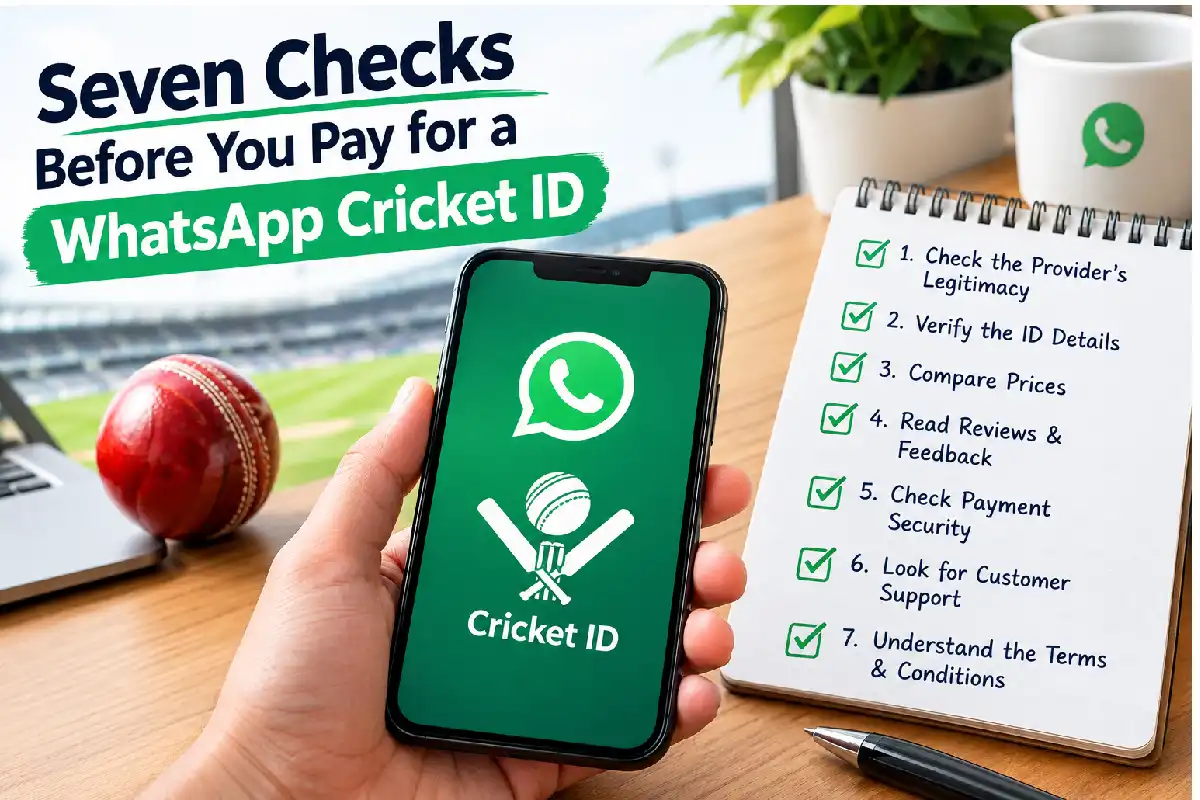
Ask a group of cricket fans in India how they got their first online cricket ID and most of the answers will sound the same. A friend forwarded a number, someone on the other end replied within a minute, a small UPI payment went across, and a username and password arrived in the chat. It is quick, it is convenient, and for a lot of people it works exactly as promised.
It is also a process built almost entirely on trust. There is no shop to walk into and no counter to stand at. Everything you know about the provider comes from a chat window and whatever you managed to find online beforehand. That is not a reason to avoid these services, but it is a very good reason to slow down for ten minutes before the first payment rather than after the first problem.
What follows are the seven checks that experienced users tend to make instinctively, written down so that newer ones can make them on purpose. None requires technical knowledge, and most take less time than reading the terms of a welcome offer.
Table of Contents
1. Find the provider before the provider finds you
The single most useful habit is also the simplest. Reach the service through its own website, not through a number that arrived in a group chat, a comment thread or a direct message. Legitimate providers publish their contact details openly and keep them consistent. Impersonators depend on people skipping this step, because a copied profile picture and a familiar brand name are enough to fool someone who is in a hurry before a match.
If the number you were given does not match the one on the provider’s own site, stop there. There is no innocent explanation that is worth the risk.
2. Notice what they ask for, and what they do not
A reasonable provider needs very little to open an account: a name, a preferred username and a working number. Some platforms ask for identity documents later, usually when a larger withdrawal is being processed, because the payment side of the business requires it. That is normal.
What is not normal is being asked for a one-time password, your card PIN, or remote access to your phone. No genuine service needs any of these. A provider who asks for an OTP “to verify you” is not verifying anything; they are taking over an account, and that request alone tells you everything you need to know.
3. Read the bonus terms before the bonus
Welcome offers are standard in this space and there is nothing wrong with taking one. The problem is that the headline number and the conditions attached to it are often two very different things. Most bonuses come with a turnover requirement before the bonus amount can be withdrawn, and the size of that requirement varies a great deal from one platform to another.
Ask the agent to state the conditions in the chat before you deposit. A good provider answers the question directly and without irritation. One who changes the subject, or tells you not to worry about it, is showing you how they will behave later when something more important is at stake.
4. Test the exit before you test the entrance
It is easy to judge a provider by how fast they open an account, because that is the part everyone experiences first. The more revealing moment comes later, when you ask for your money back. Withdrawals are where reliable services and unreliable ones separate, because it costs a weak operator nothing to take a deposit and quite a lot to return one.
A sensible approach is to make a small first deposit and request a small withdrawal early, before you have committed anything meaningful. If it arrives promptly and without new conditions appearing, that is genuinely useful information. If it stalls, you have learned something important at a price you can afford.
5. Check whether a human answers at the awkward hours
Almost every provider advertises round-the-clock support. Fewer deliver it at the moments that matter, which tend to be late at night during a close finish or early on a Sunday when a payment has not shown up. Before you sign up, send a question at an inconvenient hour and see how long a real answer takes, and whether it is a real answer or a copied script.
Support quality is not a luxury feature. When something goes wrong with money, the speed and honesty of the reply is the entire service.
6. Compare more than one option, properly
Many people end up with the first provider they hear about, which is understandable but rarely optimal. Services in this space differ in ways that are not obvious from their homepages: which sports and formats they cover, whether they offer live casino alongside cricket, how they handle verification, and how quickly withdrawals really land. Comparing two or three before choosing takes very little time and often changes the decision.
A useful starting point is a comparison published by Readdy Anna Cricket, which sets CricketIDWapp and its own service against the same questions — coverage, payments, support and safety — rather than simply listing features. Reading a comparison written that way helps you build your own checklist, whichever provider you end up choosing.
7. Decide your limits before the first match, not during it
The last check has nothing to do with the provider and everything to do with you. Decide in advance how much you are comfortable spending in a week and treat that figure as fixed. Many services will set a deposit limit on your account if you ask, and some will pause an account entirely for a cooling-off period. A provider that is happy to do this for you is showing you something about how it treats its customers.
Online gaming is meant for adults only, and the rules around it in India differ from state to state and have changed in recent years. It is worth checking what applies where you live before you begin, rather than assuming the whole country works the same way.
The scams worth recognising
Most problems in this space are not sophisticated. They work because they arrive at the right moment, usually just before a big match when people are in a hurry, and because they borrow the look of a service the victim already trusts. A few patterns account for the great majority of cases.
The first is the cloned profile: a WhatsApp account using a real provider’s name and logo, reached through a number that is one digit different from the genuine one. The second is the fake app, sent as an APK file with the promise of a faster or “premium” login. Genuine services in this space run in an ordinary mobile browser, and a file that asks for broad permissions on your phone should never be installed. The third is the release fee, where a person who has supposedly won is told to pay a charge before the winnings can be sent. That request is the scam itself, not a step in a process.
What these have in common is urgency. Each one works best when the target feels there is no time to check. Treating urgency as a warning sign, rather than a reason to act faster, protects against almost all of them.
If something does go wrong
Even careful people occasionally make a payment they regret. If money has gone to the wrong place, speed matters more than anything else. Contact your own bank or payment app first and ask them to flag the transaction, because the earlier it is reported the better the chance of stopping it. Keep every screenshot, the transaction reference and the number that contacted you, and do not delete the chat, however embarrassing it feels — it is the most useful evidence you have.
India also runs an official government portal for reporting cyber-enabled financial fraud, and filing a report there gives you a reference to follow up on. Then change your passwords, starting with your email, since that is the key to resetting everything else. None of this is pleasant, but a clear order of actions makes a bad evening considerably less bad.
A short summary
- Reach the provider through its own website, never through a forwarded number.
- Never share an OTP, PIN or remote access, whatever reason is given.
- Get the bonus conditions in writing in the chat before depositing.
- Test a small withdrawal early, before committing anything significant.
- Check support at an awkward hour before you need it.
- Compare two or three services on the same questions.
- Set your spending limit in advance and hold to it.
None of these checks takes long, and together they remove most of the ways a first online cricket ID goes wrong. The providers worth using will not mind you making them. The ones that object are answering the question for you.