
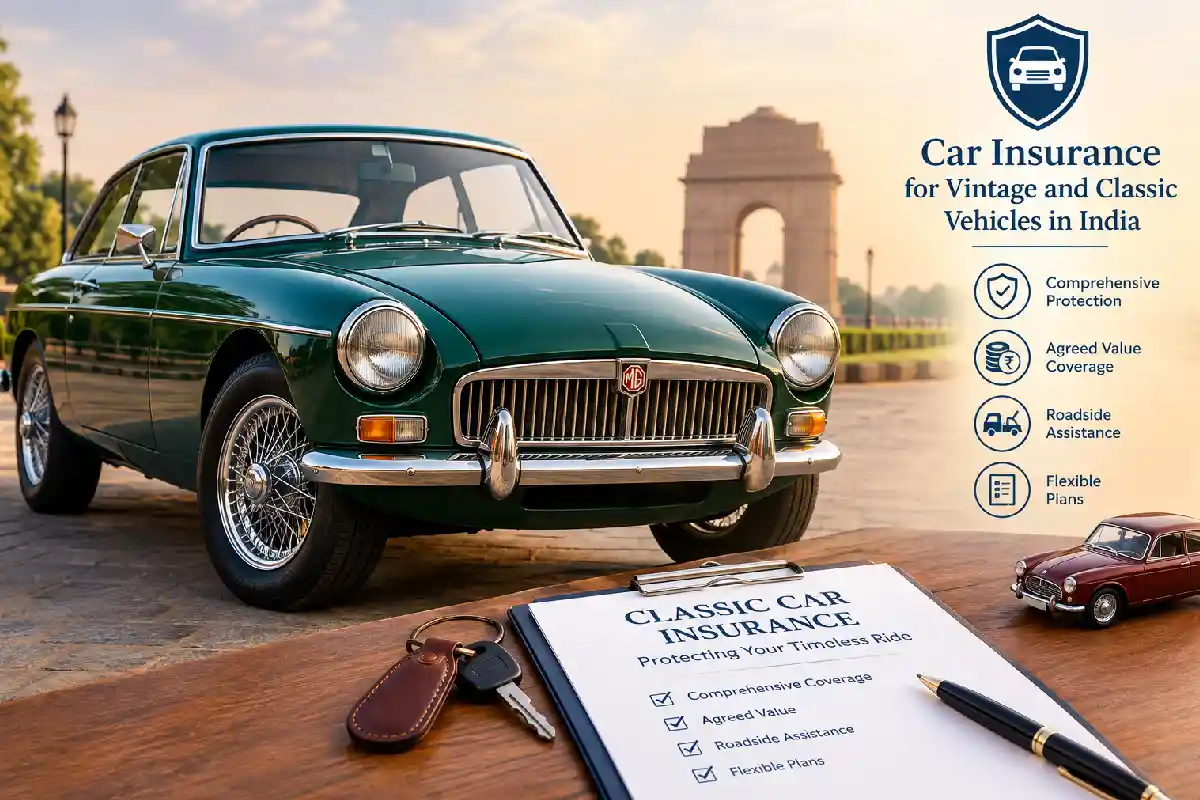
Car Insurance for Vintage and Classic Vehicles in India: Under a dust sheet in a garage in Pune sits a 1968 vintage car, which hasn’t moved twice a year, once to a rally and once to a wedding, and the owner has spent four years tracking down the exact door handle to replace.
When it’s time to renew the insurance for your vintage car, you may notice that your car’s make and model are not listed on the insurer’s website.
Old vehicles break every assumption ordinary car cover is built on, starting with the idea that a car loses value each year. In this blog, you’ll understand what current laws are for these vintage cars and how you can get the right insurance cover to protect them from any damage.
Table of Contents
What Is Considered a Car Vintage According to Law?
If we follow the amendments recently made in 2021, a four-wheeler older than 50 years or more from its date of first registration, kept in original form without substantial changes, is what qualifies as a vintage motor vehicle.
Vintage cars have their own special registration. New vintage cars get a ‘VA’ license plate, but if you already have one, you can keep your old number. These registrations run for ten years before it needs renewing.
Costs are fixed rather than negotiable. A fresh vintage registration is priced at ₹20,000, and after the ten-year renewal, it is priced at ₹5,000, which might seem expensive, but it is a big improvement over the complicated registration process these cars faced in the past.
You can only drive your vintage car for specific purposes, and this rule determines how your insurance works. A vintage registration does not permit regular commuting or commercial work, so the vehicle is expected to appear on the road for exhibitions, rallies, refuelling runs, and technical testing only, rather than be used for everyday errands.
Why the Usual Valuation Does Not Work?
Ordinary motor cover starts with a depreciation table. A normal car’s depreciation is written on a year-by-year basis from the manufacturer’s listed price, which produces a sensible number for a five-year-old car. However, doing the same for a vintage car is not the right approach.
There is no such official list for a vintage car from 1968. Its current value is determined by how original it is, the condition it is in, the history of owners or repairs, and how many similar cars have been sold recently.
Instead of following a standard pricing chart, in this case you and your insurer can agree on a set value for your car before the policy actually begins. This amount is based on things like photos, repair bills, and expert reports, and it’s the maximum they will pay if the car is destroyed. Over here, be sure to ask for the ‘agreed value’ specifically, as regular car insurance quotes tools don’t usually offer this.
What Cover Can You Actually Buy?
Third-party cover is compulsory and unavoidable. Age changes nothing about the duty to protect anyone your vehicle injures, and this half is priced on engine size like any other car.
Own damage cover is where things get selective. Not every insurer writes it for pre-1980 vehicles. Some insurers in this case only cover damage caused by events like fire, theft, or while the car is being transported to an event. Some insurance providers also need you to provide a written statement about where and how the car will be kept before offering the coverage.
Answer all of it honestly, in writing. The limited use is what makes the premium reasonable in the first place, and an insurer that later finds the car is being used for a daily commute has a clear reason to refuse the claim.
Where Repairs Get Complicated
The biggest challenge is finding the right parts. Modern insurance claims mostly assume that you can easily buy new parts for the vintage car, but these cars normally need a skilled expert to do any repairs. Because of this, it is very hard to predict the cost or time that would be needed for such repairs in advance.
Network garages rarely help here. Cashless car insurance works by sending you to a workshop the insurer already pays directly, and the specialist who understands a fifty-year-old braking system is rarely on that list.
So it is advised to plan for reimbursement instead. Get written approval from your insurer to use your own specialist for repairs. Keep all receipts from repairs and take photos of your car every year to prove its condition.
What This Cover Cannot Promise
Money does not bring back originality. An agreed value pays a number, but the numbers-matching engine, the original upholstery, and the years spent finding a door handle are not replaceable at any price.
Having car insurance is quite useful when it comes to protecting the car from events like a flood, fire, theft, or damage while transporting the vintage car somewhere. By agreeing on a value for the car beforehand and keeping your documents up to date, you can ensure that these situations are handled properly.