
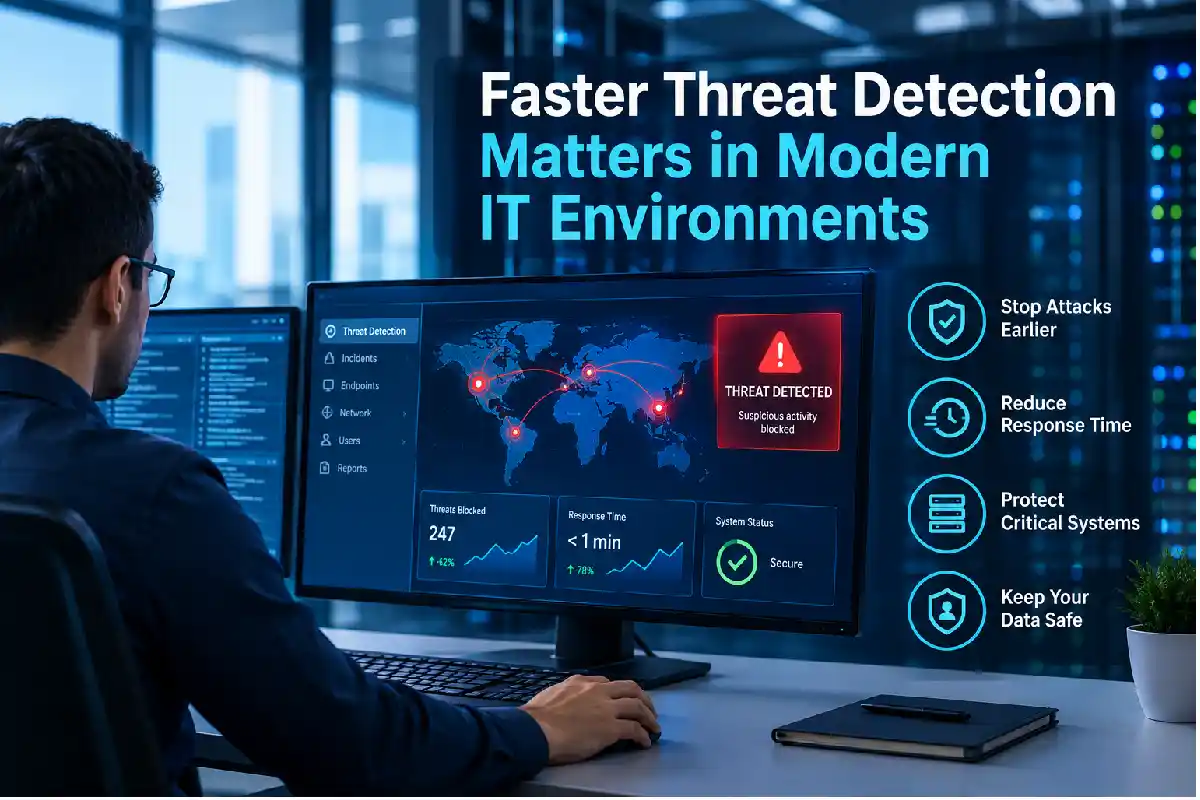
Why Faster Threat Detection Matters in Modern IT Environments: Modern IT environments are faster, more connected, and more complex than ever. Businesses rely on cloud platforms, remote access, mobile devices, third-party applications, and distributed networks to keep everyday operations moving. While this flexibility creates opportunities, it also gives cyber threats more potential entry points.
As a result, detecting suspicious activity quickly has become a critical part of business security. The longer a threat stays unnoticed, the more time an attacker may have to access sensitive information, compromise accounts, disrupt systems, or move through a network.
Table of Contents
Cyber Threats Can Develop Quickly
Cyber incidents do not always begin with an obvious system failure. An attacker might first gain access through stolen login credentials, a compromised endpoint, or a vulnerable application. Early activity can resemble legitimate user behavior, making it difficult to identify without effective monitoring.
Once access has been established, the situation can change rapidly. Attackers may attempt to increase their privileges, access additional systems, steal information, or deploy malicious software. Faster threat detection helps security teams identify these warning signs before an initial compromise develops into a much larger incident.
Modern IT Creates More Areas to Monitor
Traditional security strategies were often designed around a clearly defined network perimeter. Today, that perimeter is much harder to identify. Employees may connect from home, applications can operate across several cloud services, and business data may be stored in multiple environments.
Security teams therefore need visibility across a broad range of systems. Endpoint activity, network traffic, user behavior, cloud infrastructure, and identity systems can all provide valuable signs of potential threats.
For businesses that lack the internal resources to continuously monitor these areas, services such as MDR can form part of a wider approach to identifying, investigating, and responding to suspicious activity.
Early Detection Can Limit the Impact of an Incident
Speed is important because detection is closely connected to response. When suspicious behavior is identified sooner, security teams have more opportunity to investigate what happened and take appropriate action.
This might involve isolating an affected device, turning off compromised credentials, blocking malicious connections, or investigating other systems for related activity. Taking these steps early can help contain an incident and reduce the potential for operational disruption or data exposure.
Faster detection can also support more efficient investigations. When security teams have timely information about suspicious activity, they may be able to understand the sequence of events more clearly and make informed response decisions.
Automation Helps Security Teams Work Efficiently
The volume of security data produced by modern organizations can make manual monitoring impractical. Security tools can generate thousands of events and alerts, not all of which indicate a genuine attack.
Automation can help analyze this information, identify unusual patterns, and prioritize alerts that require attention. This allows security professionals to spend more time investigating meaningful risks rather than manually reviewing every event.
However, technology alone is not enough. Experienced security professionals remain important for interpreting alerts, understanding business context, and deciding how incidents should be handled.
Making Detection Speed Part of Security Strategy
No organization can guarantee that every cyber threat will be prevented. A strong security strategy therefore needs to consider not only how attacks can be blocked, but also how quickly suspicious activity can be discovered.
By improving visibility, monitoring important systems, using automation appropriately, and establishing clear response processes, businesses can reduce the amount of time threats remain undetected. In modern IT environments, faster detection gives security teams a better opportunity to contain incidents before they cause wider damage.