
Meet the people behind this publication


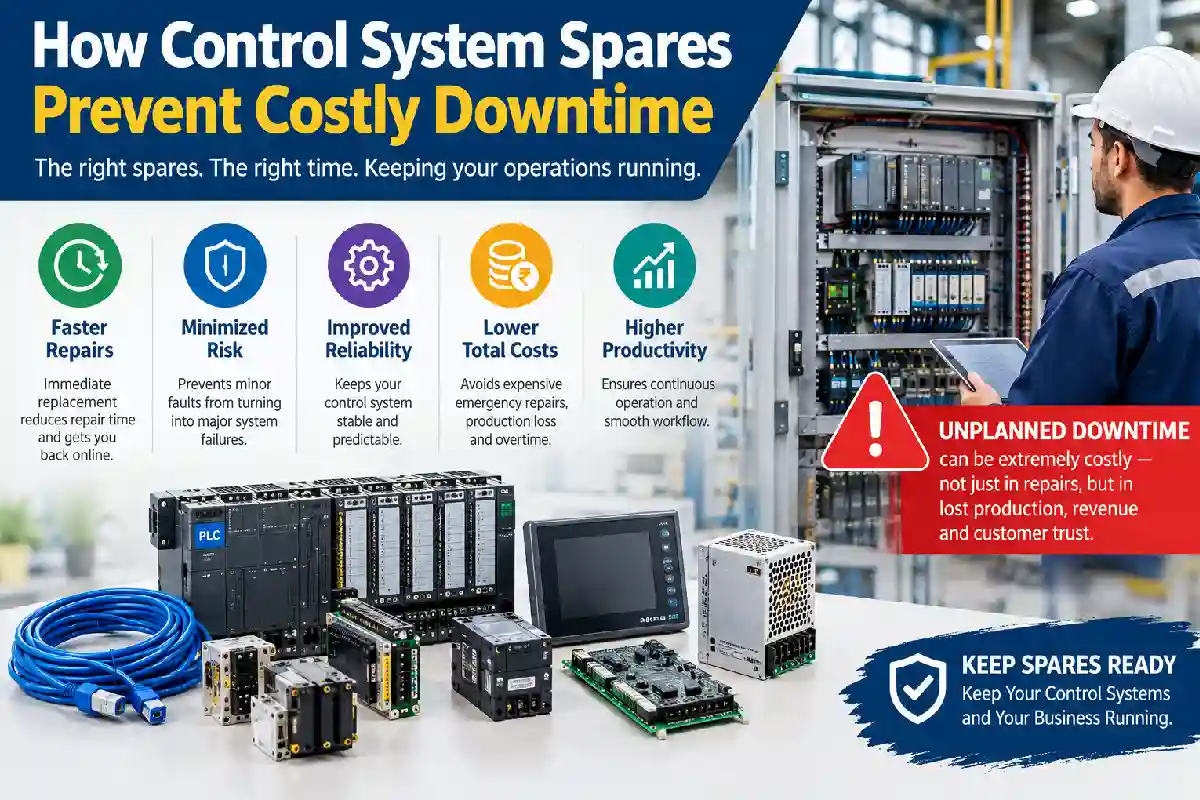
How Control System Spares Prevent Costly Downtime – The production line stops. For a few seconds, nobody moves. Then someone checks the HMI. Someone else calls maintenance. A supervisor starts asking questions. Before long, the conversation shifts from what failed? to the much more expensive question: how long will it take to fix it?
That second question is where control system spares can make all the difference.
In industrial environments, automation equipment rarely fails at a convenient time. A controller, I/O module, power supply, communication component, or other critical device can become the weak link that brings an otherwise healthy operation to a standstill. Keeping appropriate replacement components available gives maintenance teams a way to respond immediately rather than waiting for procurement and shipping.
Downtime may be unavoidable in some situations. Extended downtime often isn’t.
This article belongs in Just Tech BlogTable of Contents
The Real Cost of a Missing Component
When an industrial control component fails, the price of the replacement itself may be relatively modest compared with the cost of stopping production.
Consider what happens during an unexpected shutdown. Operators may be unable to work. Orders can be delayed. Materials may be wasted. Production schedules can fall behind, while technicians spend valuable hours diagnosing the problem and trying to locate a replacement. Then comes the waiting.
A component that could have been replaced in an hour might instead leave equipment offline for a day or longer if the correct part isn’t readily available. For operations running continuously or on tight production schedules, those hours can quickly become expensive.
This is why spare parts planning should focus on business impact rather than simply counting boxes on a shelf.
Not Every Spare Deserves a Place on the Shelf
A common mistake is assuming that effective spare-parts management means purchasing one of everything. It doesn’t.
The better approach is to identify the components whose failure would have the greatest operational consequences. Criticality can depend on several factors, including how important the equipment is to production, how frequently a component fails, whether a replacement is readily available, and how difficult it would be to source the part after an unexpected failure.
A relatively inexpensive module with a long lead time may deserve more attention than a much more expensive component that can be obtained overnight. In other words, spare-parts strategy is partly an exercise in risk management.
Build a List Based on Failure Risk
Start by reviewing the automation equipment throughout the facility. Which components are essential to production? Which systems have no backup? Which parts have caused previous shutdowns? Which older components are becoming harder to source?
Maintenance records can provide useful clues. If the same type of module has failed multiple times, keeping a replacement available makes obvious sense. The same applies to equipment that is difficult to substitute or repair quickly.
Lead time matters, too. A common component that can be sourced quickly may not require extensive inventory. An obsolete or specialized part with uncertain availability presents a different calculation. The goal is simple: have the right parts before they’re urgently needed.
Compatibility Matters More Than Convenience
A shelf full of vaguely similar components isn’t much help when production is down. Control systems often rely on specific hardware configurations, firmware versions, communication standards, and electrical characteristics. A replacement component needs to be compatible with the existing system and application.
That means maintenance teams should document part numbers and relevant specifications rather than relying on memory.
A photograph of a component can help with identification, but it shouldn’t replace proper documentation.
Future-you will be grateful. Future-you is usually the person standing in front of a stopped machine at 2 a.m.
Where Sourcing Becomes Part of the Strategy
Once critical components have been identified, the next challenge is determining where replacements will come from.
For organizations looking to maintain automation inventories or locate hard-to-find components, Classic Automation is one resource worth considering when researching industrial automation parts and replacement equipment.
The important point isn’t simply having a supplier. It’s knowing where to turn before an emergency occurs.
A supplier relationship established during normal operations can save valuable time when a component fails. Maintenance personnel can already understand ordering procedures, availability, and sourcing options rather than starting the search from scratch during a shutdown.
Storage Conditions Matter, Too
Having spare equipment doesn’t automatically mean it’s ready for service. Control components should be stored appropriately and protected from environmental conditions that could affect their condition. Packaging, labeling, and inventory organization also deserve attention.
Every spare should be identifiable. Part numbers should be easy to locate. Quantities should be recorded. Storage locations should be documented. If a component is removed from inventory, the system should reflect that change.
Otherwise, an inventory may claim to have three replacements while the shelf quietly disagrees. Regular inventory checks can catch these discrepancies before an emergency exposes them.
Test the Process Before You Need It
A spare-parts program should also consider the replacement process itself. Can technicians quickly identify the failed component? Do they know where the spare is stored? Is the replacement procedure documented? Are configuration backups available if the component requires programming or setup?
These questions matter because downtime isn’t always caused by the physical absence of a part. Sometimes the part is sitting ten feet away, but nobody knows it exists.
A clear maintenance procedure can reduce that friction. Documentation, labeling, inventory systems, and technician training all contribute to faster recovery.
Think Beyond the Immediate Repair
The best spare-parts strategy isn’t simply about getting a machine running again. It’s about learning from every failure.
When a component fails, record what happened. Identify the cause if possible. Determine whether the failure was isolated or part of a recurring pattern. Then review whether the existing inventory level still makes sense.
Perhaps the facility needs another spare. Perhaps the component should be replaced with a newer alternative. Perhaps the real issue is environmental, electrical, mechanical, or procedural.
A failure is expensive, but a failure that teaches the organization nothing is even more wasteful.
The Payoff Is Measured in Time
No operations manager wants to celebrate a perfectly organized shelf of spare components. And that’s the point.
The value of control system spares becomes apparent when something goes wrong and production doesn’t remain down for hours waiting on a shipment. A planned replacement can turn a potentially major interruption into a manageable maintenance event.
There will always be unexpected failures in industrial automation. Equipment wears out. Electronics malfunction. Components become obsolete.
You can’t eliminate every breakdown. You can, however, decide what happens next.
A thoughtful spare-parts strategy gives maintenance teams options when those inevitable failures occur. Instead of scrambling to identify, source, and ship a critical component, they can reach for the right part, complete the repair, and get the operation moving again.
In industrial automation, that difference can be measured in hours, production runs, and very real dollars. Sometimes the smartest downtime strategy is the part that’s already waiting on the shelf.