
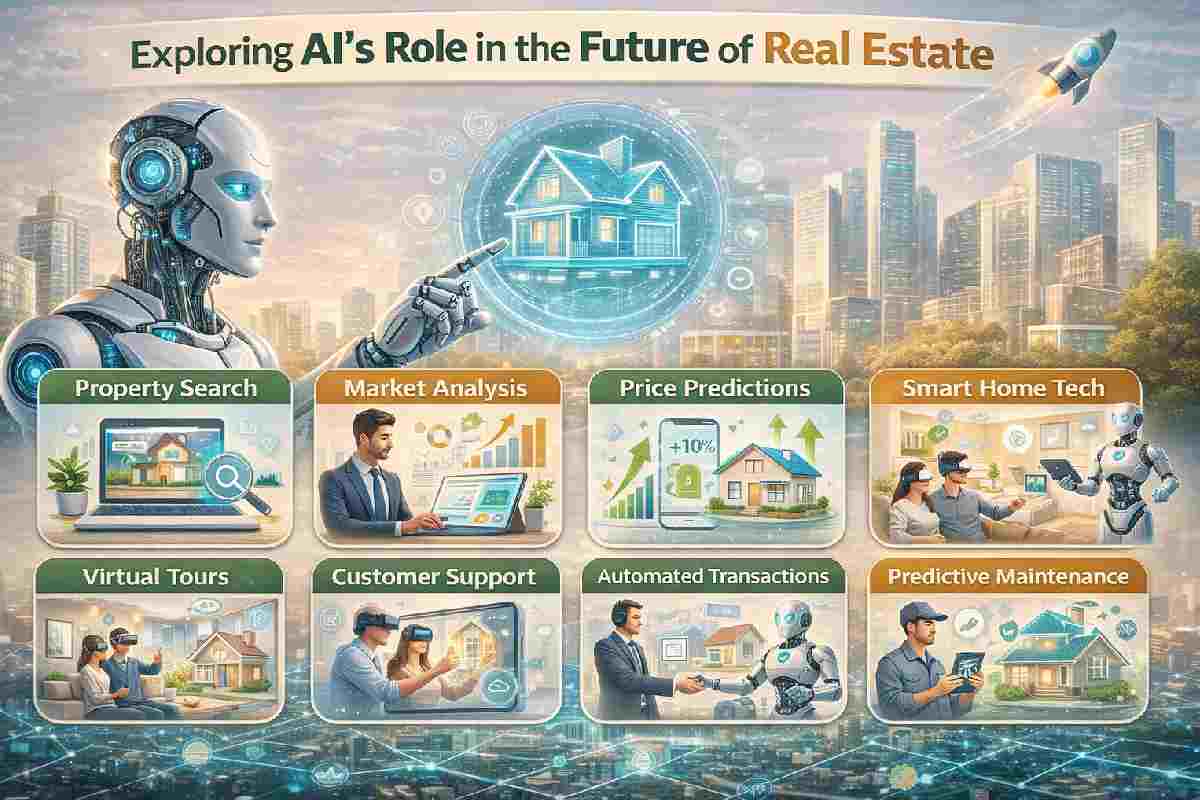
Exploring AI’s Role in the Future of Real Estate – The real estate industry has always been shaped by data—prices, locations, trends, and timing. But today, something bigger is happening. Artificial intelligence is stepping into the picture, quietly but steadily reshaping how decisions are made, how properties are managed, and how entire cities evolve.
And it’s not hype.
From predictive pricing to automated property management, AI is already influencing the way buyers, sellers, investors, and developers operate. What’s more interesting, though, is where this is all heading.
Let’s break it down.
Table of Contents
The Current Role of AI in Real Estate
AI is no longer experimental in real estate—it’s operational.
Across the industry, companies are using AI to analyze massive datasets that would take humans weeks or months to process. According to McKinsey & Company, AI and advanced analytics could generate between $110 billion and $180 billion in annual value for the sector.
That’s not small.
Smarter Property Valuation
Pricing has always been tricky. Too high, and listings sit. Too low, and value is lost.
AI changes that.
Machine learning models can analyze historical sales, neighborhood trends, economic signals, and even local infrastructure developments. Research from the Journal of Property Research shows that these models improve property price prediction accuracy by up to 25%.
That means fewer guesses—and better outcomes.
Automation Behind the Scenes
Let’s talk operations.
A large portion of real estate work is repetitive—document processing, tenant communication, maintenance tracking. AI is taking over many of these tasks.
- Lease abstraction tools extract key clauses automatically
- Chatbots handle tenant inquiries 24/7
- Maintenance requests are routed and prioritized without human intervention
In fact, about 40% of real estate processes can be automated using AI technologies, according to McKinsey & Company.
Short answer? Less manual work. More time for strategy.
Data-Driven Decision Making
Real estate decisions used to rely heavily on experience and instinct.
Now, data leads the way.
Over 65% of industry stakeholders report better decision-making through AI-powered platforms, based on insights from the World Economic Forum.
And it shows.
Investors are using predictive analytics to identify high-growth areas. Property managers are optimizing rent prices in real time. Developers are selecting sites with more confidence.
Emerging Innovations You Should Watch
If today’s AI applications are impressive, what’s coming next is even more compelling.
AI Shaping Homeowner Behavior
Consumers are no longer passive participants in the buying process.
With tools that analyze personal finances, lifestyle preferences, and market trends, AI is actively guiding decisions. One recent report highlights how AI shaping homeowner decisions is becoming a defining trend, influencing everything from mortgage choices to renovation planning.
Buyers now ask different questions:
- Can I afford this long-term?
- What will this property be worth in five years?
- Should I renovate now or wait?
AI answers them instantly.
Generative AI for Property Design
Design used to require architects, drafts, revisions, and time.
Now? You can generate multiple design concepts in minutes.
AI-powered platforms allow users to visualize layouts, experiment with materials, and simulate lighting conditions. Tools like AI renovation tools are making it easier for homeowners and developers to plan upgrades without guesswork.
This changes the relationship between clients and professionals.
It becomes collaborative.
Predictive Leasing and Occupancy
Vacancy is expensive.
AI helps reduce it.
According to JLL Research, predictive analytics can reduce vacancy rates by up to 15% and improve leasing efficiency by 20–30%.
How?
By forecasting demand shifts before they happen.
Instead of reacting to empty units, property managers can adjust pricing, marketing, and incentives ahead of time.
AI and the Rise of Smart Cities
This is where things get bigger than individual properties.
We’re talking about entire urban ecosystems.
Intelligent Buildings
Buildings are becoming more than structures—they’re becoming systems.
AI-enabled sensors track:
- Energy usage
- Occupancy patterns
- Air quality
- Maintenance needs
The result?
Lower costs and better living conditions. Smart building systems can reduce energy consumption by 10–20%, according to the World Economic Forum.
That’s good for both owners and the environment.
Urban Planning Powered by Data
City planners are using AI to simulate growth scenarios.
Where should new housing go?
How will traffic patterns change?
What infrastructure is needed?
AI models can process these variables and suggest optimal solutions.
This leads to more efficient cities—and fewer costly mistakes.
Connected Living Experiences
Think about a future where:
- Your building adjusts temperature automatically
- Elevators anticipate peak usage
- Parking spaces are allocated dynamically
That future isn’t far off.
AI connects different systems within cities, creating a more responsive environment for residents.
Future Scenarios: What Comes Next?
Let’s zoom out.
Where does all this lead?
Fully Autonomous Transactions
Buying property today involves agents, paperwork, approvals, and delays.
Tomorrow?
Much of that could be automated.
AI could:
- Match buyers and properties instantly
- Assess risk in real time
- Handle documentation without human input
Faster transactions. Fewer bottlenecks.
Hyper-Personalized Real Estate Experiences
Every buyer is different.
AI knows that.
Future platforms will offer highly personalized recommendations based on:
- Lifestyle preferences
- Career trajectory
- Financial patterns
- Even behavioral data
It won’t just show you listings—it will show you the right listings.
New Business Models
Here’s where it gets interesting.
AI is enabling entirely new ways to operate in real estate:
- Subscription-based housing
- Fractional ownership platforms
- AI-managed investment portfolios
And companies are paying attention. According to Deloitte Insights, 72% of real estate organizations are already exploring or piloting generative AI solutions.
That’s a signal.
Challenges That Can’t Be Ignored
It’s not all upside.
AI introduces new complexities that the industry must address.
Data Privacy Concerns
Real estate data is sensitive.
Financial records. Personal preferences. Location history.
If AI systems aren’t handled carefully, privacy risks increase.
Who owns the data?
Who controls it?
Who’s accountable when something goes wrong?
These questions still need clear answers.
Bias in Algorithms
AI learns from historical data.
And history isn’t always fair.
If past data includes bias—whether in pricing, lending, or location trends—AI systems can reinforce it.
That’s a serious issue.
Developers and regulators will need to monitor and correct these biases continuously.
Adoption Barriers
Not every company is ready.
Smaller firms may struggle with:
- High implementation costs
- Lack of technical expertise
- Resistance to change
Even though AI-enabled automation can reduce operational costs by up to 15–20% (as noted by Deloitte Insights), the initial investment can still be a hurdle.
Conclusion: A New Era for Real Estate
AI is not a passing trend in real estate—it’s a long-term shift that is reshaping how the industry operates at every level.
Today, it’s improving pricing accuracy, automating routine tasks, and helping professionals make better decisions. Emerging innovations are changing how homeowners plan, how buildings function, and how cities grow. Looking ahead, we’re likely to see faster transactions, more personalized experiences, and entirely new business models.
But progress comes with responsibility.
The industry must address privacy concerns, manage algorithmic bias, and support adoption across organizations of all sizes. Those challenges will shape how smoothly this transition unfolds.
One thing is clear.
Real estate is becoming more intelligent, more data-driven, and more responsive to human needs.
And we’re just getting started.